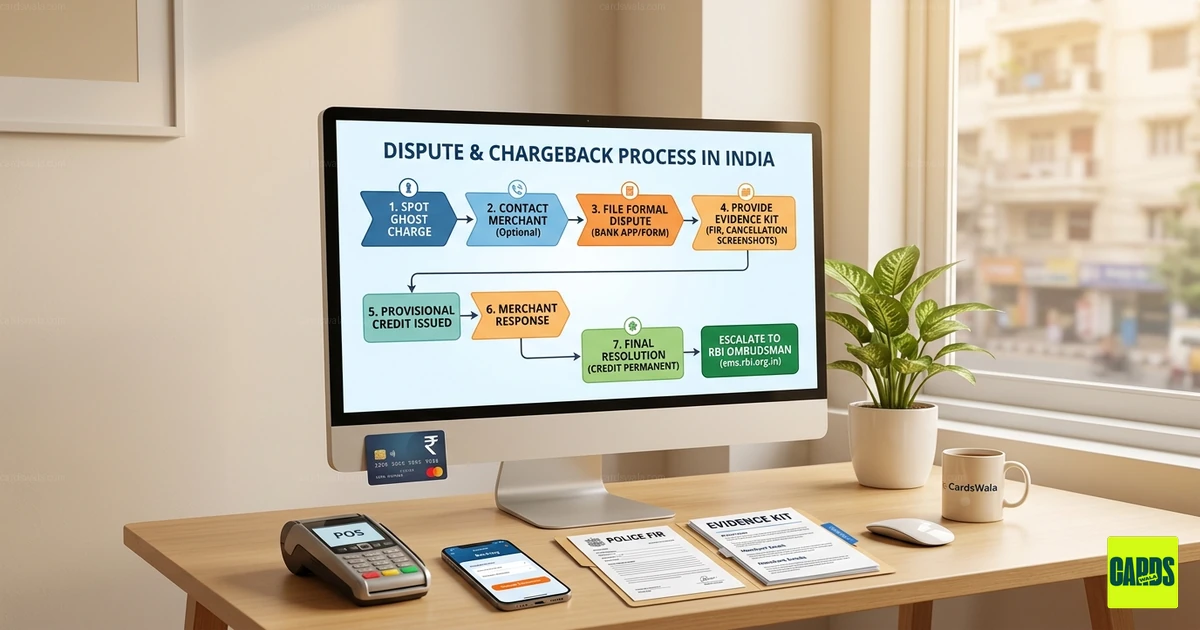
How to Dispute a Credit Card Transaction in India: A Step-by-Step Guide 💳
Have you ever scrolled through your credit card statement and spotted a "ghost charge"? Maybe it’s a double billing for your last grocery run, or worse, a high-value transaction at a store you’ve never visited. 😱
Panic is the natural first reaction, but here is the good news: Indian credit card holders are backed by some of the world's strongest consumer protection rules set by the RBI. Whether it's a technical glitch, a "free trial" that wasn't free, or outright fraud, here is your 2026 roadmap to getting your money back.
1. The "Soft" Check (Before You Call the Bank) 🔍
Before you trigger the formal dispute process, perform these quick checks:
- Look for "Trading Names": Sometimes, the name on your statement is the parent company, not the brand. (e.g., Bundl Technologies instead of Swiggy, or Zomato Ltd for Blinkit).
- Contact the Merchant: For non-fraud issues (like a cancelled hotel booking), email the merchant first. A simple "Hey, I was charged twice" often results in a refund within 5–7 days. 📩
- Keep Proof: Save a screenshot of your conversation with the merchant. You’ll need it if they refuse to cooperate.
2. Raise a Formal Dispute (The "Chargeback") 🛡️
If the merchant ignores you or the transaction is clearly fraudulent, it’s time to move to the formal Chargeback process.
How to do it:
- Via Banking App: Most modern Indian banks (HDFC, ICICI, Axis, SBI) now have a "Dispute Transaction" button directly inside the transaction details in your app. 📱
- Via Email/Form: If your app doesn't have it, search for your bank's "Transaction Dispute Form" (TDF). Fill it out and email it to the dedicated disputes ID (e.g.,
disputes@hdfcbank.com). - The 120-Day Rule: Per RBI and card network (Visa/Mastercard/RuPay) rules, you generally have 120 days from the transaction date to raise a dispute. Don't wait! ⏳
3. Provide Your "Evidence Kit" 📑
The bank acts as a judge between you and the merchant. To win, you need to provide your "Evidence Kit":
- For Fraud: A copy of the Police FIR or a screenshot of the "Cyber Crime" complaint filed at cybercrime.gov.in. 👮
- For Services Not Provided: Screenshots of your cancellation email or the merchant’s "Order Failed" screen.
- For Duplicate Charges: A copy of your statement highlighting both identical charges.
💡 Pro Tip: Once you file a valid dispute, the bank is often required to provide a "Provisional Credit." This means the money is temporarily put back in your account so you don't have to pay interest on it while they investigate.
4. The Investigation Timeline 🗓️
| Phase | Timeline | What Happens |
|---|---|---|
| Acknowledgement | Days 1–10 | Bank logs the dispute and issues provisional credit. ✅ |
| Merchant Response | Days 11–45 | The merchant must prove the charge was valid (e.g., showing a delivery receipt). 📤 |
| Final Resolution | Days 45–90 | If you win, the credit is permanent. If you lose, the bank re-charges the amount. ⚖️ |
5. The "Nuclear" Option: RBI Ombudsman 🏛️
What if your bank is being unhelpful or rejects a legitimate claim?
Under the Reserve Bank-Integrated Ombudsman Scheme (RB-IOS), if you don't get a satisfactory resolution within 30 days of your complaint, you can escalate it to the RBI.
- Where to file: cms.rbi.org.in
- Why it works: The Ombudsman is a free, independent body. If the bank was negligent, the RBI can award you compensation for financial loss and even "mental agony" (up to ₹3 lakh). 💰
Quick Summary Checklist 👛
- Suspected Fraud 🚨: Block card immediately -> File Cyber Crime report -> Raise dispute.
- Cancelled Order 📦: Email merchant -> Wait 7 days -> Raise dispute with email trail.
- Expired Subscription 🔄: Show proof of cancellation -> Raise dispute.
The Bottom Line: You are not helpless. As long as you act within the 120-day window and keep your "paper trail" ready, the Indian banking system is heavily skewed in favor of the consumer.
Check Out These Cards
CardsWala Crew
Credit Card Expert & Financial Writer