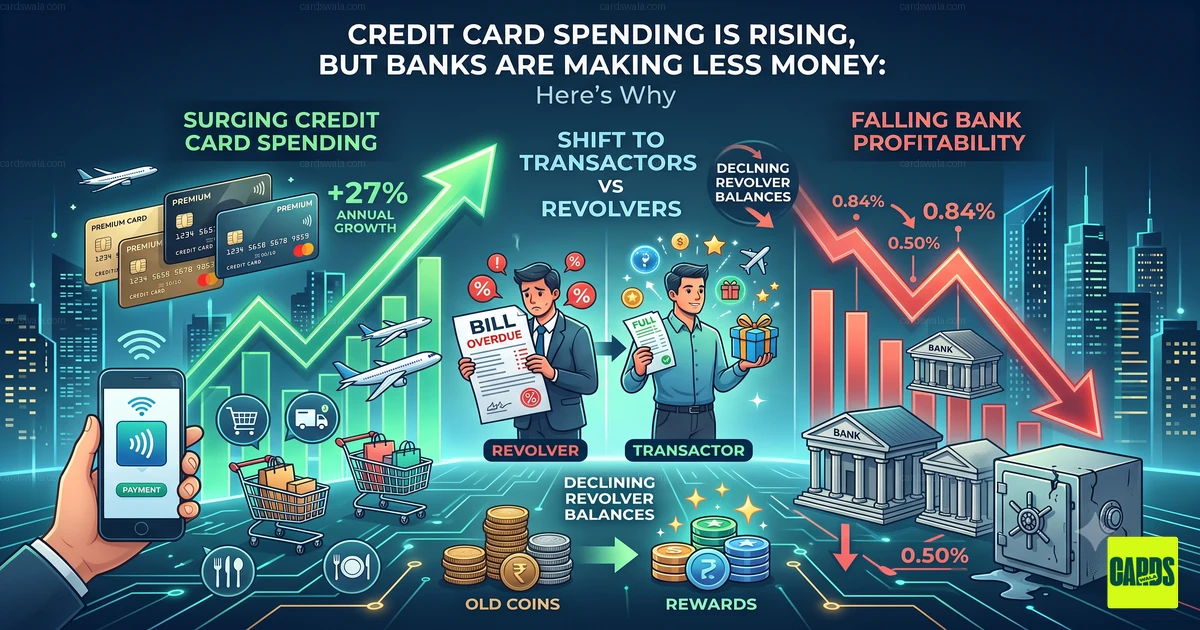
💳 Credit Card Spending Is Rising, But Banks Are Making Less Money: Here’s Why
India's credit card market is growing rapidly. More people are getting credit cards, spending more on them and using them for everything from online shopping to travel and dining.
But there is an interesting twist.
📈 Credit card spending is increasing, while the profitability of credit cards for banks is falling.
At first, this may sound contradictory. If customers are spending more, shouldn't banks be making more money?
Not necessarily.
The reason comes down to one simple change in customer behaviour: Indians are increasingly using credit cards for payments rather than borrowing.
And that is changing the economics of the credit card industry.
💰 How Do Banks Make Money From Credit Cards?
To understand what is happening, it helps to first understand how banks make money from credit cards.
There are several sources of revenue, including:
- 💳 Interest charged on outstanding balances
- 📆 Interest earned when customers convert purchases into EMIs
- 🏪 Merchant and interchange-related income
- 💵 Annual and other card fees
- 🤝 Partnerships and co-branded card arrangements
However, one of the most profitable customers for a bank has traditionally been a revolver.
🔄 What Is a Credit Card Revolver?
A revolver is someone who does not pay the entire credit card bill by the due date.
For example, suppose you spend ₹50,000 on your credit card.
If you pay the entire ₹50,000 before the due date, you generally don't pay interest on that spending.
But if you pay only part of the bill and carry the remaining balance forward, the bank can charge interest on the outstanding amount.
This is where credit card issuers can earn significant income.
The problem for banks is that fewer customers are doing this today.
📉 Indians Are Revolving Less on Their Credit Cards
According to industry estimates cited by Bernstein, revolver balances and EMI loans have fallen to around 11% of annual credit card spending, compared with roughly 21% several years ago.
At the same time, credit card spending grew at an annual rate of nearly 27% between FY2021-22 and FY2025-26.
So we have two very different trends:
Credit card spending → 📈 Increasing
Interest-earning balances → 📉 Declining relative to spending
This is the key reason credit cards are becoming less profitable for banks.
🧾 Customers Are Becoming ""Transactors""
The Indian credit card customer is gradually changing.
Instead of using a credit card as a convenient source of short-term borrowing, many customers now use it as a payment and rewards tool.
These customers are sometimes referred to as transactors.
They spend on their credit cards and then pay the entire bill every month.
Why?
Because they can enjoy benefits such as:
- 🎁 Cashback
- ⭐ Reward points
- ✈️ Air miles
- 🏨 Hotel rewards
- 🍽️ Dining offers
- 🛫 Airport lounge access
- 🛍️ Shopping discounts
without paying credit card interest, provided they clear their outstanding balance in full.
From the customer's perspective, this is obviously attractive.
From the bank's perspective, however, it means losing out on one of the most lucrative sources of credit card income.
🏦 HDFC Bank Is Seeing the Impact
The changing behaviour is already visible at some of India's largest credit card issuers.
At HDFC Bank, the credit card advances-to-spends ratio has fallen to around 17%, compared with approximately 27% in FY2018-19.
The decline in interest-earning credit card advances has also reduced the bank's overall portfolio yield by around 50–60 basis points, according to Bernstein.
In simple terms, HDFC Bank is still processing a huge amount of credit card spending.
But a smaller portion of that spending is turning into interest-earning credit.
💳 SBI Cards Shows a Similar Trend
SBI Cards provides another good example.
During the June quarter, retail spending on SBI Cards increased 14% year-on-year to ₹94,033 crore.
However, receivables grew by only around 3% to ₹58,269 crore.
More importantly, interest income declined by around 3% year-on-year to ₹2,421 crore.
The decline in revolving balances is particularly noticeable.
🔄 In March 2020, revolvers accounted for around 40% of SBI Cards' receivables.
Today, that figure is around 22%.
Including EMI loans, interest-earning receivables have declined to around 55%, from 60% a year earlier.
SBI Cards is therefore looking at increasing EMI conversions to compensate for the decline in revolving credit.
📊 Banks Are Earning Less From Every Rupee Spent
Perhaps the most interesting number in the entire story is the estimated profit generated from credit card spending.
Bernstein estimates that profit generated by banks for every rupee spent through credit cards fell to around 0.50% in FY2025-26, from 0.84% in FY2016-17.
It expects this figure to decline further to around 0.43% by FY2028-29.
That means the growth in credit card spending isn't translating into the same level of profitability that banks enjoyed in the past.
🤔 Why Is This Happening?
The answer is relatively straightforward.
Customers are spending more, but borrowing less through their credit cards.
And interest income is an important part of the credit card business.
💡 Why Are Customers Revolving Less?
There isn't necessarily one single reason.
1️⃣ Better Financial Awareness
Consumers are becoming more aware of how expensive credit card debt can be.
Credit card interest rates can be very high, so financially disciplined customers often prefer to pay their entire bill rather than carry a balance.
2️⃣ More Borrowing Alternatives
Consumers today have access to personal loans, consumer durable loans, EMI facilities and other forms of digital credit.
If someone needs to borrow money for several months, a personal loan or structured EMI product may be more attractive than revolving a credit card balance.
3️⃣ Credit Cards Have Become Rewards Products
This is perhaps the biggest behavioural shift.
For many users, the main reason to own multiple credit cards isn't the credit limit.
It is the rewards ecosystem.
A customer may use one card for groceries, another for online shopping, another for travel and another for fuel.
The goal is to maximise cashback, reward points or miles.
4️⃣ More Selective Card Issuance
Banks have also become more careful about whom they onboard.
The industry has increasingly focused on acquiring customers with stronger credit profiles and spending potential.
That can be good for asset quality, but it may also mean fewer customers who regularly carry balances.
📈 Is This Bad News for Credit Card Users?
Not necessarily.
In fact, it could be good news for responsible credit card users.
Banks still want customers to spend more on their cards.
That means competition between issuers can continue to drive:
- 🎁 Better welcome offers
- 💰 Cashback campaigns
- ⭐ Reward points
- ✈️ Travel benefits
- 🏨 Hotel partnerships
- 🛫 Lounge access
- 🎯 Milestone benefits
But there is an important catch.
Banks need to make the economics of their cards work.
If interest income from revolvers continues to fall, issuers may look at other ways to improve profitability.
That could mean changes to:
- Reward rates
- Cashback caps
- Annual fees
- Milestone benefits
- Lounge access
- Merchant offers
- Reward exclusions
We have already seen banks modify reward structures across various categories in recent years.
🔮 What Does the Future Hold for Credit Cards in India?
The Indian credit card industry is unlikely to stop growing.
However, the business model is changing.
The old model was relatively simple:
Issue cards → encourage spending → earn interchange and other fees → earn substantial interest from customers who revolve.
The newer model is increasingly about:
Acquire high-quality customers → encourage spending → build engagement → monetise through payments, fees, EMIs and other financial products.
This is a significant shift.
The decline in revolvers is not necessarily a sign that people are using credit cards less.
In fact, the opposite is happening.
People are using them more frequently, but differently.
🧠 What Should Credit Card Users Do?
For consumers, the takeaway is quite simple.
If you can afford to pay your entire credit card bill every month, using the right credit card can be extremely rewarding.
For example, if you spend ₹1 lakh every month, choosing a card with the right cashback or rewards structure can potentially generate thousands of rupees worth of benefits over a year.
But don't spend more just to earn rewards.
And most importantly:
⚠️ Never Carry a Credit Card Balance Just to Earn Rewards
A few hundred or thousand rupees of cashback can quickly become meaningless if you end up paying substantial interest on your outstanding balance.
🏁 The Bottom Line
India's credit card spending story is still very much a growth story.
But the way Indians use credit cards is changing.
📈 Spending is rising.
🔄 Revolving balances are falling.
💰 Interest income is under pressure.
🎁 Rewards and payment benefits are becoming increasingly important.
For banks, this means the traditional revolver-led credit card model is becoming less attractive.
For consumers who pay their bills in full, however, the shift could create an interesting opportunity.
As banks compete for profitable customers, we could see continued innovation in cashback credit cards, reward credit cards, travel cards and premium credit cards.
So the next phase of India's credit card boom may not simply be about how many cards are issued.
It could be about how much customers spend, how loyal they are, and how effectively banks can monetise that spending without relying heavily on revolving debt.
Check Out These Cards
CardsWala Crew
Credit Card Expert & Financial Writer