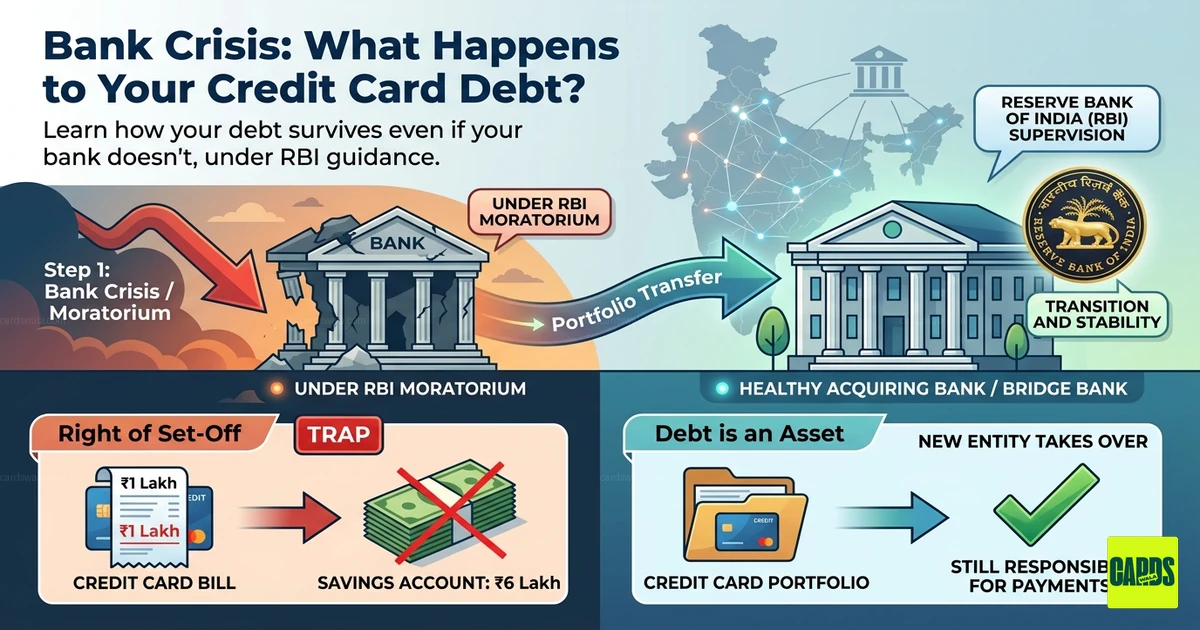
Bank Crisis: What Happens to Your Credit Card Debt? 💳📉
In the rare event that an Indian bank "goes under" or is placed under a moratorium by the Reserve Bank of India (RBI), depositors often panic about their savings. But for credit card holders, the reaction is often: "If the bank is gone, maybe my debt is gone too?"
The short answer: No. In fact, managing your credit card during a bank failure requires even more caution to avoid a long-term financial nightmare. Here is how credit card settlements and outstandings work when a bank faces a crisis in India.
1. Your Debt is an "Asset" (For Someone Else) 📂
Even if a bank's physical doors are locked, your credit card balance doesn't disappear. In legal terms, your debt is a receivable asset.
- The Transition: If the bank is liquidated or merged (like the Lakshmi Vilas Bank or YES Bank crises), your loan/credit card portfolio is usually transferred to a "bridge bank" or a healthy acquiring bank. 🏦
- The Responsibility: You still owe that money. You will eventually receive instructions on where to direct your payments. Ignoring them can lead to legal action by the new entity. ⚖️
2. The DICGC Rule: The "Set-Off" Trap 🪤
The Deposit Insurance and Credit Guarantee Corporation (DICGC) insures your deposits up to ₹5 Lakh. However, there is a legal maneuver called the Right of Set-Off.
If you have ₹6 Lakh in a savings account and a ₹1 Lakh credit card bill at the same failing bank:
- The bank has the right to "set off" your debt against your deposit.
- Instead of getting your full insured amount, the bank might deduct your credit card outstanding first.
- Result: You’d receive ₹5 Lakh (the insurance limit), and your ₹1 Lakh debt would be "settled" using your own trapped savings. 💸
3. Can You Negotiate a Settlement? 🤝
If the bank is in the process of closing, you might be tempted to ask for a "settlement" (paying less than what you owe).
- One-Time Settlements (OTS): Liquidators want to recover money quickly to pay back depositors. They might offer an OTS to clear the books. 📉
- The CIBIL Catch: Even during a bank failure, a settlement is reported to credit bureaus. Your report will show the account as "Settled" rather than "Closed," which can tank your credit score for up to 7 years. 📉🚫
4. What Happens to Your Rewards and Benefits? 🎁
This is where cardholders usually lose out the most.
- Reward Points: If the bank's operations are suspended, your reward points usually become worthless instantly. Use them or lose them! 🎟️
- Refunds/Chargebacks: If you were expecting a refund for a cancelled flight or a disputed transaction, the process becomes a bureaucratic nightmare that could take months or years. ⏳
⚠️ Pro-Tips for Credit Card Users in India
- Don't Stop Paying: Even if the mobile app is down, keep records of your attempts to pay. Unpaid interest and penalties will continue to accrue. 📈
- Get the NOC: If you reach a settlement, ensure you get a physical No Objection Certificate (NOC). In the chaos of a bank closure, digital records can get messy. 📄
- Diversify Your Banks: Never keep your primary savings account and your primary credit card at the same bank. This prevents a "set-off" from freezing your entire financial life. 🛡️
The Bottom Line 🎯
A bank failure isn't a "get out of debt free" card. While the bank's future might be uncertain, the RBI's recovery mechanism is incredibly robust. Treat your credit card dues as a priority because while the bank might disappear, your CIBIL score is forever.
Check Out These Cards

CardsWala Crew
Credit Card Expert & Financial Writer