📉 Why Your CIBIL Score Dropped Suddenly? 5 Common Reasons Explained
It’s a Monday morning, you check your credit app, and instead of that proud 780+, you see a sudden, ugly drop. Your heart sinks. You haven’t missed a major payment, so what gives? 😰
In India, your CIBIL score is your financial reputation. A sudden dip can be the difference between getting a low-interest home loan or being rejected outright. If you’re staring at a lower number today, don’t panic—it’s usually due to one of these five common (and often fixable) reasons.
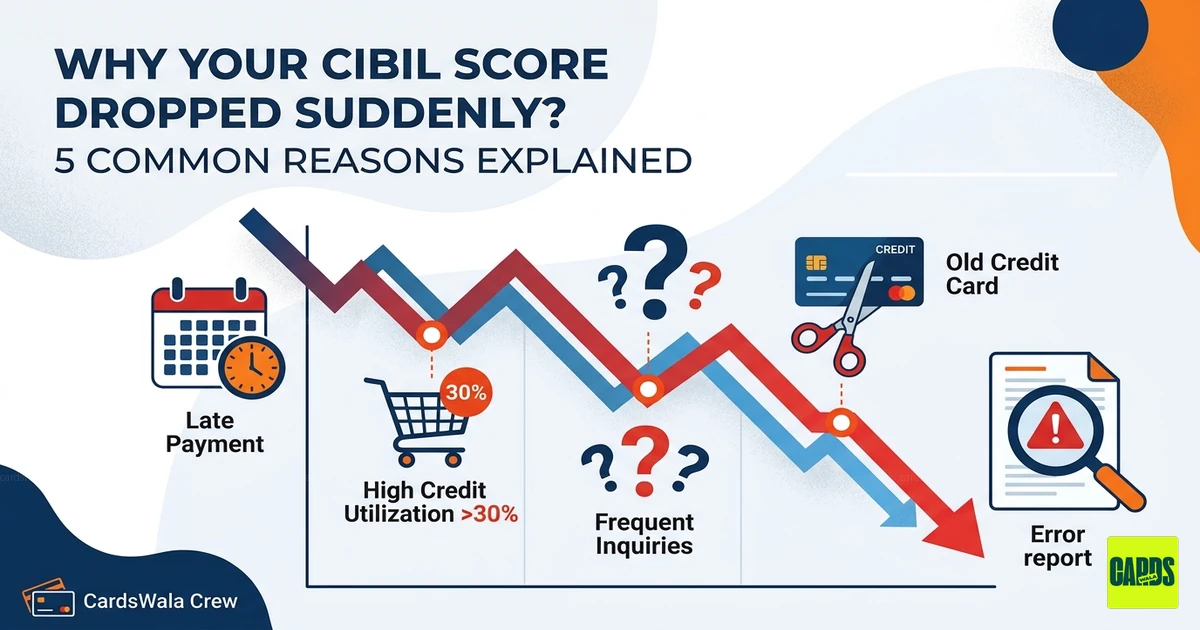
1. The "Hidden" Late Payment 🕒
This is the #1 culprit. Even if you didn't miss a "big" EMI, a small ₹500 credit card fee or a forgotten utility bill linked to a credit line (like a BNPL account) can do massive damage.
- The 30-Day Rule: Most banks report to CIBIL every 30–45 days. If you were even a few days late last month, it might just be showing up now.
- Weightage: Payment history accounts for roughly 35% of your score. One late entry can knock off 50–100 points instantly. ⚠️
2. You’re "Credit Hungry" (Too Many Enquiries) 🍔
Did you recently apply for a Personal Loan, a new Credit Card, and an Amazon Pay Later limit all in the same week?
- Hard Enquiries: Every time you apply for credit, the lender pulls your report. This is a "Hard Enquiry."
- The Signal: To CIBIL, multiple enquiries in a short time signal that you are desperate for cash. This makes you look "high-risk," and your score drops to warn other lenders. 🚫
3. High Credit Utilization Ratio (CUR) 💳
In the world of credit, "maxing out" is a red flag. This is measured by your Credit Utilization Ratio.
- The Sweet Spot: You should ideally use less than 30% of your total limit.
- The Trap: If your limit is ₹1 Lakh and you spent ₹80,000 this month (even if you plan to pay it back in full), CIBIL sees you as over-leveraged. The moment that high balance is reported, your score will dip. 📈
4. Closing an Old Credit Card ✂️
It sounds responsible to close a card you don't use, right? Wrong. * Credit Age: A long, clean credit history is gold. If you close your oldest credit card, you effectively "shorten" your credit age.
- Reduced Limit: Closing a card also reduces your total available credit limit, which instantly bloats your Utilization Ratio (see point #3).
Pro-Tip: If the card has no annual fee, keep it active! Use it for a small recharge once a year just to keep the history alive. 💡
5. Mistakes in the CIBIL Report 🔍
Sometimes, the drop isn't your fault at all. Errors are more common than you think.
- Clerical Errors: A bank might fail to update a loan as "Closed," or worse, someone else's default might be wrongly tagged to your PAN due to a technical glitch.
- Identity Theft: Sudden drops can occasionally be an early warning sign of fraudulent loans taken in your name. 🚨
🛠️ How to Fix a Dropped CIBIL Score?
- Check Your Report Monthly: Use platforms like OneScore, GPay, or the official CIBIL site to monitor changes.
- Raise a Dispute: If you see an error, use the CIBIL Dispute Resolution portal. It usually takes 30 days to rectify.
- The "30% Rule": Pay down your credit card balances immediately to bring your utilization back under 30%.
- Set Up Auto-Pay: Never miss a deadline again. In 2026, automation is your best friend for financial health. ✅
Check Out These Cards

CardsWala Crew
Credit Card Expert & Financial Writer