Decoding the Indian Credit Card Ecosystem: A Complete 2026 Guide 💳
Whether you are tapping a sleek metal card at a high-end cafe in Mumbai or scanning a UPI QR code at a local shop in Thane, you are participating in one of the most sophisticated financial networks in the world. As of 2026, India’s credit card ecosystem has moved beyond simple "plastic money" into a high-speed, multi-layered digital infrastructure.
1. The Key Players: Who’s in the Loop? 👤
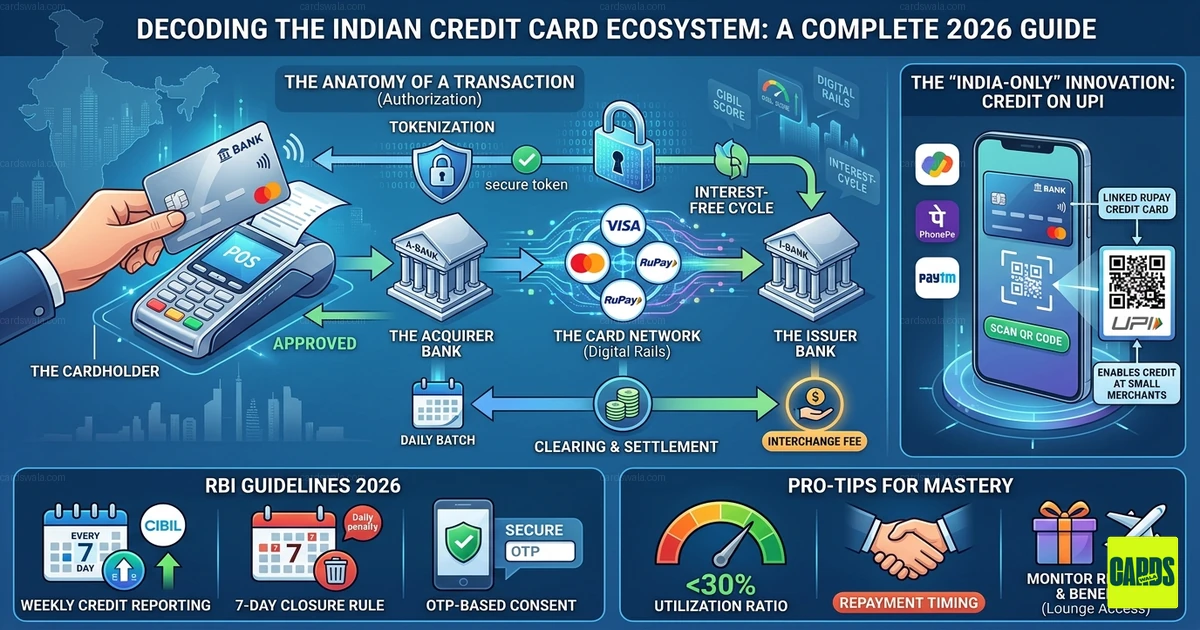
When you use a credit card, you aren’t just interacting with a bank. Four main entities work together in a split-second relay:
- The Cardholder (You): 💳 The consumer granted a revolving credit line based on creditworthiness.
- The Merchant: 🏪 The shop, service provider, or website where you are spending.
- The Acquirer Bank: 🏦 The merchant’s bank that provides the POS (Point of Sale) machine or online payment gateway.
- The Issuer Bank: 🏛️ Your bank (e.g., HDFC, ICICI, SBI) that issued the card and manages your credit limit.
- The Card Network: 🌐 The "digital rails"—Visa, Mastercard, or RuPay. They provide the communication bridge that allows the Issuer and Acquirer to talk to each other.
2. The Anatomy of a Transaction ⚙️
Every transaction follows a precise three-step sequence to ensure security and speed.
Step 1: Authorization 🔓 (The "Can I buy this?" stage)
- The Process: When you tap or scan, the Acquirer sends a request to the Network, which then asks the Issuer, "Does this user have enough limit?"
- Tokenization: In 2026, your actual 16-digit card number is never shared with the merchant. Instead, a secure Token 🔑 is used to protect your data.
- The Approval: If the bank confirms the funds and security check, the transaction is approved, and your credit limit is blocked instantly. ✅
Step 2: Clearing & Settlement 💸 (The "Pay the Merchant" stage)
Money doesn't actually leave your bank account the second you tap.
- Batching: At the end of the day, the merchant "batches" all approved transactions and sends them to their Acquirer Bank.
- The Exchange: The Network facilitates the movement of funds. Your Issuer Bank pays the Acquirer Bank, which then deposits the money into the merchant's account.
- The Interchange Fee: 📉 A small fee is deducted during this process, which is how the banks and networks sustain the infrastructure.
3. The "India-Only" Innovation: Credit on UPI 🤳
India has pioneered a unique hybrid model that is now being studied globally.
- The RuPay Revolution: ⚡ You can now link your RuPay credit cards directly to apps like Google Pay or PhonePe. This allows you to use credit at millions of small vendors who don't have a traditional POS machine.
- Digital Credit Lines: In 2026, banks are increasingly offering "Pre-approved Credit Lines" on UPI, effectively making physical cards optional for the average user.
4. The Rules of the Game: RBI Guidelines 2026 📜
The Reserve Bank of India (RBI) has implemented strict rules to protect cardholders:
- Weekly Credit Reporting: 🗓️ As of April 2026, banks now report your repayment behavior to credit bureaus (like CIBIL) every 7 days. This means your credit score updates almost in real-time.
- The 7-Day Closure Rule: Banks must close a credit card account within 7 working days of a request, or they face a daily penalty of ₹1,000 payable to the customer.
- Consent First: 🛑 No credit limit increases or new card activations can happen without explicit OTP-based consent from you.
5. The Math: Cycles and Interest 🔢
Understanding the cycle is the difference between a "free loan" and a "debt trap."
| Feature | How it works in 2026 🕒 |
|---|---|
| Billing Cycle 🔄 | Usually 30 days. Spend on day 1, and you get up to 50 days of interest-free credit. |
| APR (Interest) 📈 | If you carry a balance, interest rates in India can range from 36% to 48% annually. |
| Minimum Due ⚠️ | This usually only covers the interest and taxes. Paying only this keeps you in debt for years. |
| Utility Surcharges ⚡ | Most Indian banks now charge a 1% fee for utility payments (electricity, rent) exceeding ₹50,000/month. |
6. Pro-Tips for Credit Mastery 💡
- Utilization Ratio: 📉 Keep your spending below 30% of your total limit. Because of weekly reporting, a high balance on Monday could lower your score by Friday, even if you pay it off by Sunday.
- Repayment Timing: Always pay 2-3 days before the due date to account for settlement delays between different banking systems.
- Monitor Your Rewards: 🥂 Lounge access and milestone benefits are now strictly tied to "minimum monthly spends" (often ₹35,000+). Check your bank app regularly to see if you've qualified.
The Bottom Line 🎯
The credit card system in India is no longer just about spending; it’s about managing a sophisticated digital identity. By understanding how the "rails" work—from tokenization to UPI integration—you can turn your credit card into a powerful wealth-building tool.
Check Out These Cards
CardsWala Crew
Credit Card Expert & Financial Writer