How to Check Your Credit Card Balance and Due Amount (All Banks, 2026)
Missing your credit card due date triggers hefty late fees and wrecks your CIBIL score. Checking your balance takes seconds, but you must look at the right numbers to avoid interest shocks.
The Three Numbers You Must Know
When you check your account, you will see three distinct figures. Understanding what each means is critical for your financial health.
| Metric | What It Means | Action Required |
|---|---|---|
| Total Amount Due | The exact sum of all transactions, EMIs, fees, and taxes from your last billing cycle. | Pay this in full before the due date to avoid all interest charges. |
| Minimum Amount Due | Usually ~5% of your Total Due plus any monthly EMIs. | Paying this avoids late fees but triggers massive daily interest on the remaining balance. |
| Available Limit | Your total credit limit minus current outstanding unbilled transactions and merchant holds. | Always spend within this number to avoid over-limit penalties. |
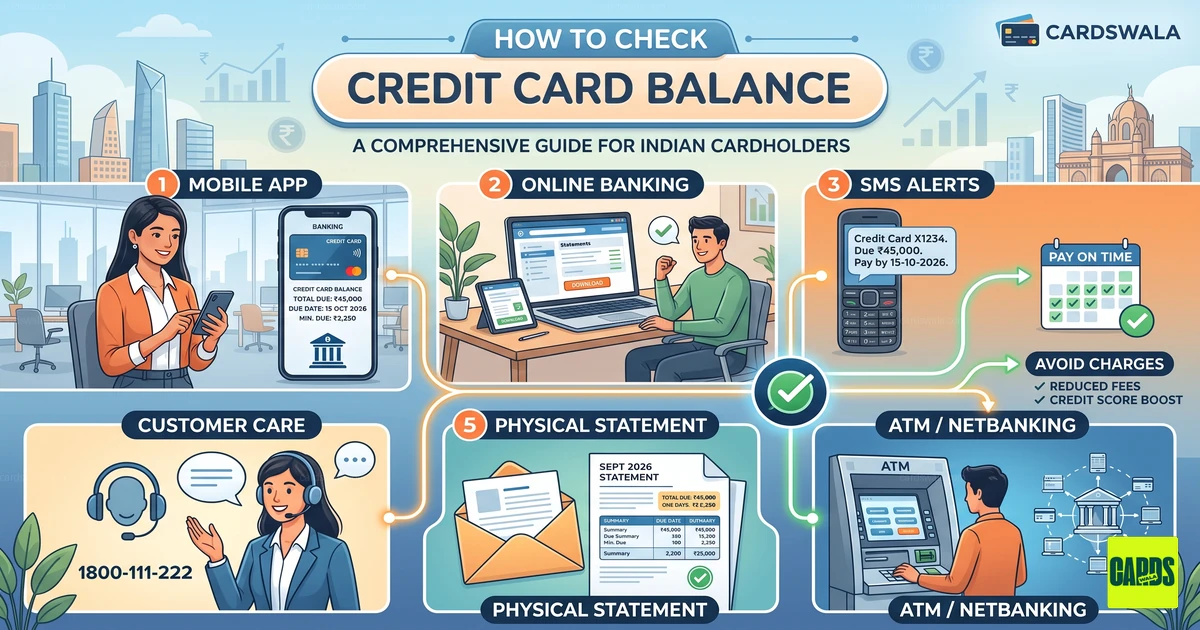
5 Ways to Check Your Balance Instantly
1. Mobile Banking App & Netbanking: This is the fastest and most accurate channel. Log into your bank's app (like HDFC, ICICI, or SBI Card). The home screen will immediately display your unbilled amount, Total Due, and Available Limit.
2. WhatsApp Banking: Most major Indian banks now offer WhatsApp banking. Send a simple "Hi" from your registered mobile number to your bank's official WhatsApp account and navigate the menu to "Credit Card Balance."
3. UPI Apps (For RuPay Cards): If you are linking your credit card to UPI apps like BHIM, PhonePe, or Google Pay, you can check your available balance directly within the app using your UPI PIN. This only works for RuPay network cards.
4. SMS Banking: Send a specific keyword (usually "BAL" followed by the last 4 digits of your card) to your bank's designated SMS number. You will receive an instant reply with your available limit and total outstanding.
5. Statement PDF & IVR: Your monthly email statement contains your final billed due amount. Learn how to parse it correctly with our beginner's guide to reading credit card statements. Alternatively, call the customer care number on the back of your card and follow the automated IVR prompts.
3 Warnings Before You Pay
- The Minimum Due Trap: Never settle for just the minimum. If your Total Due is ₹50,000 and your Minimum Due is ₹2,500, paying only ₹2,500 means the remaining ₹47,500 attracts interest up to 40% annually. Understand the difference between full and minimum payments to protect your money.
- Payment Clearing Lag: If you pay your bill via a third-party app, it can take 2 to 3 working days to reflect. Your available limit will not update immediately.
- Merchant Holds: Sometimes hotels or rental services block a specific amount on your card as a security deposit. This reduces your Available Limit even if the amount does not show up in your billed Total Due.
Stay on top of your balances to maintain a healthy credit score. If you are ready for a new card, explore the live card listings.
Check Out These Cards
CardsWala Crew
Credit Card Expert & Financial Writer