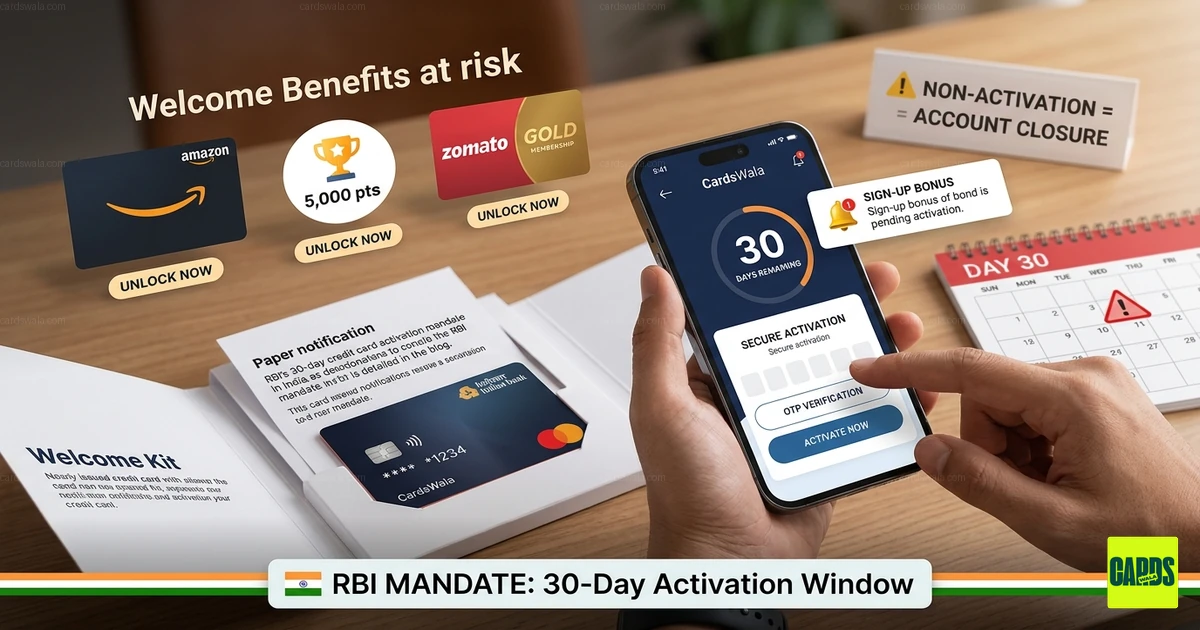
Why Activating Your Credit Card in the First 30 Days Matters 💳
Getting a new credit card is exciting—the sleek design, the promise of rewards, and the boost to your purchasing power. However, that card is just a piece of plastic until you activate it. In India, the first 30 days are no longer just a grace period; they are a critical window defined by regulatory mandates and financial strategy.
Here is why you should move "Activate Credit Card" to the top of your to-do list. ✅
1. The RBI’s 30-Day Mandate 🏛️
The Reserve Bank of India (RBI) has strict guidelines regarding card activation to protect consumers from unsolicited cards. If a customer does not activate their credit card within 30 days of issuance, the card issuer is required to seek explicit consent (typically OTP-based) to keep the card open.
- The Consequence: If you fail to provide consent or activate the card within this window, the bank is mandated to close the credit card account within seven working days. ⚠️
- The Impact: A closed account before it even starts is a major hassle. You may have to re-apply, leading to unnecessary paperwork and a wasted hard inquiry on your credit report.
2. Safeguarding Your Welcome Benefits 🎁
Most premium and lifestyle credit cards offer "Welcome Benefits" or "Sign-up Bonuses" to offset the joining fee. These often include:
- Bonus Reward Points (e.g., 5,000 points on first spend). 📈
- Activation Vouchers (Amazon, Flipkart, or Myntra). 🛍️
- Complimentary Memberships (Zomato Gold, Swiggy One, or Times Prime). 🍴
These benefits are frequently contingent on activating the card and making a first transaction within the first 30 days. If you miss this window, you lose the primary value proposition of the card.
3. Impact on Your Credit Score 📉
Every time you apply for a credit card, the bank performs a "Hard Inquiry" on your credit profile, which causes a small, temporary dip in your score.
- If the card is closed due to non-activation, you’ve taken the "hit" of a hard inquiry without gaining the benefit of an increased total credit limit.
- Credit Utilization Ratio (CUR): A new card increases your total available credit. By keeping it active, you lower your CUR, which is one of the fastest ways to improve your credit score. 🚀
4. Detection of Fraud or Transit Issues 🛡️
Activating your card immediately allows you to verify that the card reached you safely and is functioning correctly.
- Physical Integrity: Ensure the welcome kit hasn't been tampered with.
- Digital Setup: Activating the card forces you to set up your PIN and manage usage limits (International, Contactless, Online) via the banking app. This is your first line of defense against unauthorized transactions. 🔒
5. Milestone Tracking Starts Now ⏱️
Many cards offer annual fee waivers or "milestone rewards" based on yearly spends (e.g., spend ₹2 Lakhs to waive the ₹500 fee).
The clock for these milestones typically starts from the date of issuance, not the date of your first spend. Delaying activation effectively shortens the time you have to meet these targets, making it harder to get that fee waiver.
Summary: The 30-Day Activation Window 📊
| Factor | Impact of Quick Activation | Risk of Delay |
|---|---|---|
| Regulatory | Complies with RBI norms | Automatic account closure |
| Rewards | Unlocks welcome vouchers | Forfeiture of benefits |
| Credit Score | Improves Credit Utilization | Wasted Hard Inquiry |
| Security | Immediate PIN/Limit control | Undetected transit fraud |
💡 Pro-Tip: The "Token" Transaction
Once you activate your card via the app or IVR, make a small token transaction—like a mobile recharge or a small grocery bill. This ensures the card is fully functional on the payment rails and solidifies your "active" status with the bank.
Don't let your new financial tool go to waste. Open the app, set your PIN, and start maximizing your rewards today! 💳✨
Check Out These Cards
CardsWala Crew
Credit Card Expert & Financial Writer