CIBIL vs. Experian vs. Equifax vs. CRIF: Which Credit Score Matters Most? 🎯
When you apply for a loan or a credit card in India, your financial destiny is often boiled down to a single three-digit number. But here is the catch: you don’t have just one credit score. You actually have four.
In India, the Reserve Bank of India (RBI) has licensed four Credit Information Companies (CICs): TransUnion CIBIL, Experian, Equifax, and CRIF High Mark.
While they all measure your "creditworthiness," they often show different numbers. This leads to the ultimate question: Which bureau matters most for your loan approval? Let’s break it down.
The Big Four: At a Glance 📊
All four bureaus use a scoring range of 300 to 900. While the math behind the scenes differs, the goal is the same: predicting how likely you are to repay a debt.
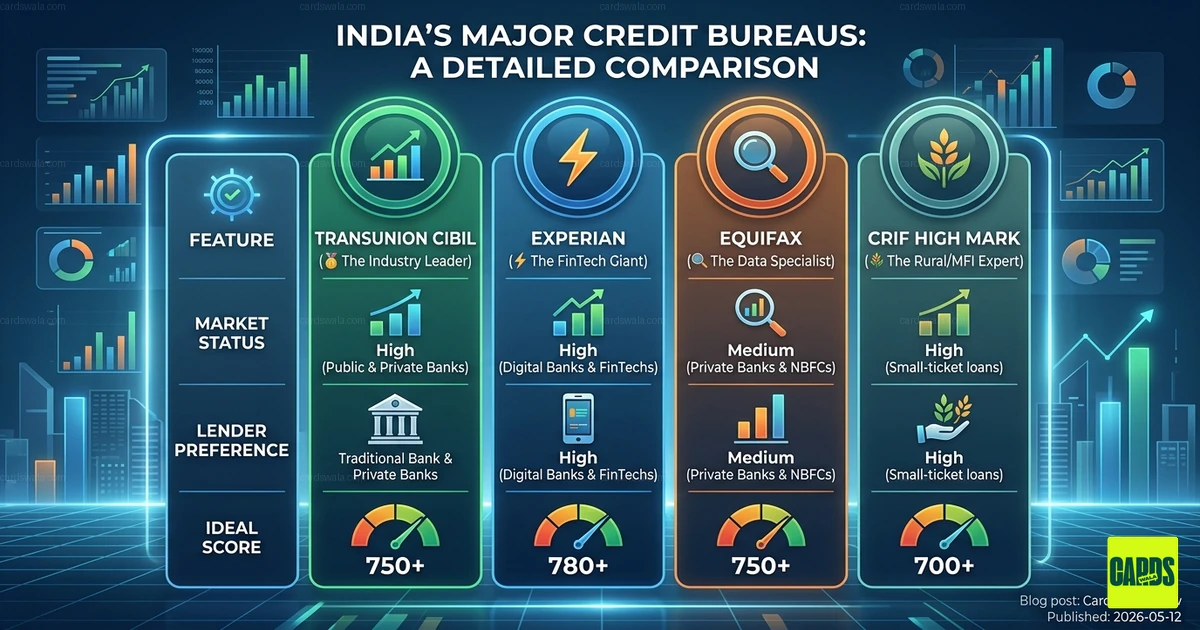
| Feature | TransUnion CIBIL | Experian | Equifax | CRIF High Mark |
|---|---|---|---|---|
| Market Status | 🏆 The Industry Leader | ⚡ The FinTech Giant | 🔍 The Data Specialist | 🌾 The Rural/MFI Expert |
| Lender Preference | High (Public & Private Banks) | High (Digital Banks & FinTechs) | Medium (Private Banks & NBFCs) | High (Small-ticket loans) |
| Ideal Score | 750+ | 780+ | 750+ | 700+ |
1. TransUnion CIBIL: The Gold Standard 🥇
CIBIL is the oldest and most influential credit bureau in India. Because it has the most extensive historical data, it is the primary choice for traditional institutions.
- Best for: Home Loans, Car Loans, and Education Loans.
- Who uses it: Major public sector banks (like SBI) and large private players (HDFC, ICICI).
- The Verdict: If you want a big-ticket loan with a low interest rate, this is the score that matters most.
2. Experian: The Digital Disruptor 📱
Experian is a global giant that has become the "go-to" for the digital lending revolution. It’s often the score you see when you check your credit on apps like CRED, GPay, or Paytm.
- Best for: Instant Credit Cards and App-based Personal Loans.
- Who uses it: Tech-savvy NBFCs and digital lending platforms.
- The Verdict: Great for "New-to-Credit" individuals who haven't built a CIBIL history yet.
3. Equifax: The Comprehensive Analyst 📋
Equifax doesn't just look at the number; it looks at the story. Their reports are highly detailed, focusing on individual credit behavior and trends.
- Best for: Personal Loans and retail credit.
- Who uses it: A mix of private banks and specialized NBFCs.
- The Verdict: Important for borrowers with a diverse mix of credit types.
4. CRIF High Mark: The Micro-Credit King 🏘️
CRIF holds a massive database for the Microfinance (MFI) and rural lending sectors. It captures a segment of the population that other bureaus might miss.
- Best for: Small business loans and microfinance.
- Who uses it: Small Finance Banks and rural lenders.
- The Verdict: Essential if you are operating in the MSME or micro-credit space.
Why Are My Scores Different? 🧐
It is perfectly normal to have a 780 on Experian but only a 745 on CIBIL. Here is why:
- 🕒 Reporting Lag: Lenders report data to bureaus at different times. One bureau might be "behind" by a few weeks.
- ⚖️ Different Weightage: CIBIL might prioritize Credit Mix, while Experian might weigh Payment History more heavily.
- 🚫 Data Gaps: Some smaller lenders only report to one or two bureaus to save costs.
CIBIL vs Experian Head-to-Head ⚔️
The single most-searched bureau duel deserves a direct verdict:
| Question | CIBIL | Experian |
|---|---|---|
| Who checks it? | SBI, HDFC, ICICI for big loans & flagship cards | CRED/GPay/Paytm surfaces; NBFCs & fintech lenders |
| Good score | 750+ | 780+ (different scale behavior) |
| When it decides | Home/car loans, premium cards | Instant cards, app-based personal loans |
| Free report | 1/year via CIBIL + partners | 1/year + bureau-partner free checks |
Bottom line: "CIBIL vs Experian" isn't either/or — banks check CIBIL for size, fintechs check Experian for speed. Track both; dispute errors on both.
Final Verdict: Which One Should You Track? 🎯
If you are planning a major life milestone—like buying a home or a car—CIBIL is the king. Most traditional banks will look at your CIBIL report first.
However, in today's economy, a multi-bureau approach is best:
- Check CIBIL for long-term loan eligibility.
- Check Experian for digital offers and credit cards.
- Check All Four at least once a year to ensure there are no errors or "ghost" accounts dragging you down.
Pro-Tip: Under RBI guidelines, you are entitled to one free full credit report from each of these four bureaus every calendar year. Use them!
Check Out These Cards
CardsWala Crew
Credit Card Expert & Financial Writer